
Language development in toddlers grows fastest through everyday interactions with parents and caregivers. Every conversation, story, song, and shared activity helps children build vocabulary, understand sentence structure, and develop the confidence to communicate. While every toddler reaches language milestones at a different pace, the quality and frequency of daily communication have a lasting impact on speech and language development.
Many parents wonder whether they are doing enough to help their toddler learn to talk. The good news is that supporting language development does not require expensive educational toys or structured lessons. Simple routines such as talking during meals, reading bedtime stories, singing songs, and describing everyday activities provide repeated opportunities for toddlers to hear new words, practice communication, and connect language with real-life experiences.
This guide explains practical, evidence-informed strategies that parents can use to support language development at home. You’ll learn how toddlers acquire language, which daily activities have the greatest impact, which habits may slow progress, and when delayed speech may require professional evaluation. By understanding these foundations, you can create a language-rich environment that encourages your toddler to communicate with confidence every day.
What helps toddlers develop language skills?
Toddlers develop language skills through frequent, responsive interactions with the people around them. Language learning begins long before children can speak in complete sentences. As toddlers listen to conversations, observe facial expressions, hear words repeated in meaningful situations, and receive responses to their own sounds or gestures, they gradually learn how language works. Every interaction helps them connect words with objects, actions, emotions, and experiences.
Responsive communication is one of the most important factors in language development because it turns everyday moments into learning opportunities. When a toddler points to a dog and a parent responds, “Yes, that’s a big brown dog. The dog is running,” the child hears new vocabulary in a meaningful context. This back-and-forth interaction strengthens both receptive language, which is the ability to understand words, and expressive language, which is the ability to use words to communicate.
Children also learn language through repetition and consistent exposure. Hearing familiar words during meals, playtime, bath time, or bedtime helps toddlers recognize patterns and remember new vocabulary. Repeating words in different situations allows children to understand that language can describe people, objects, actions, and feelings across many everyday experiences.
A language-rich environment does not require special teaching methods. Talking about what you are doing, naming objects around the house, reading books together, singing songs, and encouraging simple conversations throughout the day provide continuous opportunities for language growth. These small but consistent interactions build vocabulary, improve comprehension, and help toddlers gain confidence as they learn to express themselves.
How can parents support language development every day?
Parents can support language development by creating frequent opportunities for meaningful conversation throughout the day. Toddlers do not learn language only during dedicated learning activities. They acquire new words and communication skills by hearing language used naturally during everyday routines. The more children participate in conversations, the more opportunities they have to understand vocabulary, practice sentence formation, and build confidence when expressing themselves.
Talking during daily routines is one of the simplest and most effective strategies. Describe what you are doing while preparing meals, folding laundry, getting dressed, or walking outside. Instead of giving short instructions such as “Put on your shoes,” expand the conversation by saying, “Let’s put on your blue shoes before we go to the park. We’ll see birds, trees, and maybe a big yellow bus.” This repeated exposure introduces new vocabulary while helping toddlers connect words with real-life experiences.
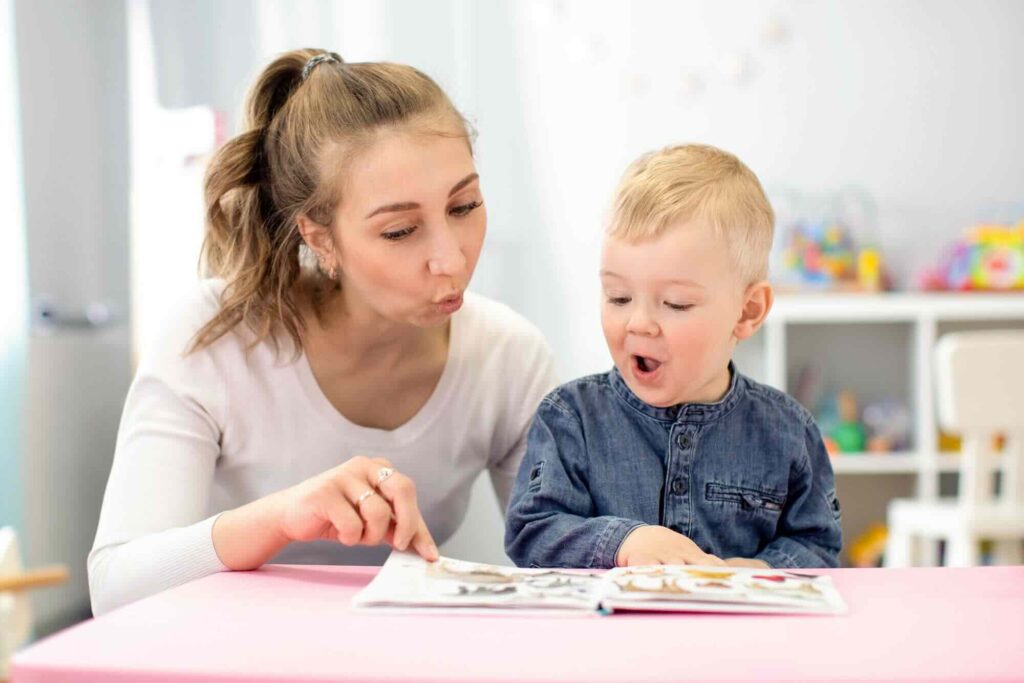
Reading aloud every day strengthens both vocabulary and listening comprehension. Choose books with colorful illustrations, repetitive phrases, and simple stories that encourage interaction. Pause to ask questions, point to pictures, and invite your toddler to name familiar objects or predict what might happen next. Even if your child cannot answer in complete sentences, participating in the conversation supports language growth.
Singing songs, nursery rhymes, and action games helps toddlers recognize the rhythm and sound patterns of language. Repeated lyrics make new words easier to remember, while movements such as clapping, pointing, or waving reinforce meaning through physical actions. Songs that include counting, animals, colors, or body parts also introduce vocabulary in an engaging way.
Pretend play encourages toddlers to use language with purpose. Activities such as cooking with toy food, caring for dolls, building with blocks, or pretending to visit a grocery store create natural opportunities to introduce new words and practice conversations. Instead of directing the play, follow your child’s interests and expand on what they say. If your toddler says, “Baby sleep,” you might respond, “Yes, the baby is sleeping in the crib because she’s tired.”
Parents can further support language development by describing their child’s actions and expanding simple sentences. If a toddler says, “Big truck,” respond with, “Yes, that’s a big red truck driving down the road.” This technique introduces richer vocabulary and more complete sentence structures without making the child feel corrected. Asking open-ended questions such as “What do you think will happen next?” or “Which toy do you want to play with?” also encourages longer responses and helps toddlers practice organizing their thoughts into words.
What habits can slow language development?
Several everyday habits can reduce opportunities for toddlers to practice communication and gradually slow language development. Most of these habits do not directly cause speech or language disorders, but they can limit the number of meaningful conversations children experience during the period when the brain is developing language most rapidly.
Excessive screen time is one of the most common barriers to language learning. Toddlers learn new words by interacting with real people, not simply by hearing words from a screen. Television shows, videos, and educational apps rarely respond to a child’s facial expressions, gestures, or attempts to communicate. Replacing conversations with passive screen viewing reduces the back-and-forth exchanges that help children build vocabulary, understand sentence structure, and develop social communication skills.
Speaking for a child can also delay opportunities to practice language. Parents naturally want to help when their toddler struggles to express a need, but answering every question or finishing every sentence prevents children from developing confidence in their own communication. Giving toddlers extra time to respond encourages them to organize their thoughts, choose words independently, and participate more actively in conversations.
Correcting every pronunciation or grammar mistake may discourage toddlers from speaking. Early language development focuses on communication rather than perfect speech. Instead of pointing out errors, repeat the child’s message using the correct words and sentence structure. For example, if a toddler says, “Doggy run,” respond with, “Yes, the dog is running very fast.” This approach provides a correct language model while keeping the conversation positive and engaging.
Background television and constant household noise can also interfere with language learning. Continuous sounds make it more difficult for toddlers to focus on conversations and distinguish individual words. Turning off the television during meals, playtime, and family activities creates a quieter environment where children can hear speech more clearly and participate in meaningful interactions.
Another habit that limits language growth is asking mostly yes-or-no questions. Questions such as “Are you hungry?” or “Do you like this?” usually produce one-word answers. Open-ended questions encourage toddlers to use more vocabulary and longer phrases. Asking “What would you like to eat today?” or “What do you think the teddy bear is doing?” gives children more opportunities to practice expressing ideas and build conversational skills.
What language milestones should toddlers reach?
What are the expected milestones from 12–18 months?
Most toddlers between 12 and 18 months begin understanding far more words than they can say. During this stage, many children respond to their name, follow simple one-step directions, recognize the names of familiar people and objects, and use gestures such as pointing or waving to communicate. Their spoken vocabulary often grows from a few recognizable words to around 10–20 words by 18 months, although individual development varies.
Parents can encourage progress by naming objects repeatedly, reading simple picture books, and responding enthusiastically whenever their toddler attempts to communicate. Even if a child uses only single words or gestures, treating every attempt as a conversation reinforces the idea that communication has meaning and encourages further language development.
What are the expected milestones from 18–24 months?
Language development typically accelerates between 18 and 24 months. Many toddlers experience a vocabulary burst during this period, learning new words almost every week. By the age of 2, many children use at least 50 words and begin combining two-word phrases such as “more milk,” “Daddy home,” or “big truck.” They also become better at following two-step instructions and identifying common objects, body parts, and familiar pictures in books.
Parents can support this rapid growth by expanding simple phrases into complete sentences. For example, if a toddler says, “Want juice,” a parent can respond, “You want more apple juice in your blue cup.” This natural expansion introduces new vocabulary and sentence structure while keeping the conversation enjoyable and pressure-free.
What are the expected milestones from 2–3 years?
Between 2 and 3 years, toddlers begin using language to share ideas, ask questions, and participate in simple conversations. Vocabulary often increases to several hundred words, and many children start speaking in three- to five-word sentences. They can answer simple questions, describe familiar experiences, understand basic concepts such as colors and size, and follow multi-step directions during everyday activities.
This stage is also when conversation becomes increasingly important. Parents can encourage language development by asking open-ended questions, reading stories with more detailed plots, and allowing toddlers enough time to respond without interruption. Frequent conversations about daily experiences, feelings, and pretend play help children organize their thoughts, strengthen grammar, and develop confidence in expressing themselves.
When should parents seek professional help?
Parents should seek professional advice if a toddler consistently misses major language milestones or shows signs that communication skills are not progressing over time. Every child develops at an individual pace, but steady progress is expected throughout the toddler years. A pediatrician or speech-language pathologist can determine whether slower language development reflects normal variation or requires further evaluation.
One warning sign is having very few or no spoken words by around 18 months. Another concern is a toddler who rarely attempts to communicate through words, gestures, eye contact, or facial expressions. Children who do not respond consistently to their name, have difficulty following simple instructions, or seem unable to understand familiar words may also benefit from an assessment to identify possible hearing, developmental, or language-related challenges.
Parents should also pay attention if a toddler stops using words or communication skills they previously mastered. Losing language abilities is not considered a typical part of development and should be discussed with a healthcare professional as soon as possible. Early identification allows families to receive appropriate support before communication difficulties begin affecting learning, behavior, or social interactions.
A speech-language pathologist can evaluate both receptive language, which refers to understanding spoken language, and expressive language, which involves using words, gestures, and sentences to communicate. Based on the evaluation, the specialist may recommend language-building activities at home, regular speech therapy sessions, or additional assessments if other developmental concerns are present.
Early intervention is most effective when language delays are identified promptly. Research consistently shows that children who receive support during the first years of life often make greater progress because the brain is especially responsive to language learning during early childhood. Seeking professional advice does not automatically mean a child has a long-term disorder. In many cases, it provides reassurance for parents or identifies simple strategies that help children reach their communication potential more effectively.
Does growing up bilingual affect language development?
Growing up bilingual does not cause language delays in typically developing toddlers. Children are capable of learning two languages at the same time when they receive regular, meaningful exposure to each language. Although bilingual toddlers may know fewer words in each individual language during the early stages, their combined vocabulary across both languages is often similar to that of monolingual children.
It is normal for bilingual toddlers to switch between languages or use words from both languages in the same sentence. This behavior, known as code-mixing, reflects normal language development rather than confusion. As children’s vocabulary and grammar become more advanced, they gradually learn when to use each language depending on the person or situation.
Parents can successfully support bilingual language development by speaking the language they use most naturally and consistently. Rich conversations, shared reading, storytelling, singing songs, and everyday interactions are more valuable than trying to follow strict language rules. Children benefit most when they hear fluent, meaningful language from parents and caregivers who actively engage them in conversation.
If parents are concerned about a bilingual toddler’s communication skills, language development should be evaluated across both languages instead of only one. A child who appears to have limited vocabulary in English, for example, may demonstrate age-appropriate communication in another language spoken at home. Professionals with experience in bilingual development can provide a more accurate assessment and determine whether additional support is needed.
Frequently Asked Questions
How much should I talk to my toddler each day?
There is no recommended number of minutes parents should spend talking to a toddler each day. What matters most is providing frequent, responsive conversations throughout everyday routines. Talking during meals, playtime, bath time, car rides, and bedtime exposes toddlers to a wide range of vocabulary in meaningful situations. Instead of focusing on the quantity of words, focus on creating many opportunities for back-and-forth interaction where your child can listen, respond, and participate.
Can music improve toddler language development?
Yes, music can support language development when it encourages active participation. Songs, nursery rhymes, and finger plays help toddlers recognize speech sounds, rhythm, and word patterns. Repetitive lyrics also make new vocabulary easier to remember. Singing together while adding gestures or movements strengthens the connection between words and actions, making language more meaningful and engaging for young children.
Are educational apps enough for language learning?
No, educational apps should not replace conversations with parents or caregivers. Some high-quality apps can introduce vocabulary or interactive stories, but toddlers learn language most effectively through real-life communication. Responsive conversations allow adults to answer questions, expand vocabulary, and adjust language based on a child’s interests, something digital content cannot consistently provide. If parents choose to use educational apps, they should participate alongside their child and continue discussing what they see and learn together.
What toys encourage language development?
The best toys for language development encourage interaction rather than passive entertainment. Building blocks, dolls, toy kitchens, toy animals, vehicles, puzzles, and pretend-play sets naturally inspire conversation because children create stories, describe actions, and ask questions while playing. Picture books, puppets, and everyday household objects can also support language development by encouraging parents and toddlers to explore new vocabulary together.
Conclusion
Supporting language development in toddlers begins with simple conversations repeated every day. Reading books, singing songs, describing everyday activities, asking open-ended questions, and following your child’s interests all create valuable opportunities for language learning. These interactions help toddlers build vocabulary, understand how conversations work, and develop the confidence to express their thoughts.
Parents do not need specialized lessons or expensive learning materials to encourage communication. A language-rich home is built through consistent, responsive interactions that make children feel heard and motivated to participate. While every toddler develops at an individual pace, regular engagement and positive communication provide the strongest foundation for long-term language, learning, and social development.
If you ever notice that your toddler is not making steady progress or is missing important language milestones, speaking with a pediatrician or speech-language pathologist can provide guidance and reassurance. Early support helps identify communication challenges sooner and gives children the best opportunity to develop strong language skills as they grow.