
A baby’s room is too hot when the temperature or sleep setup causes the baby to become overheated. Parents should pay attention to both the room temperature and the baby’s physical signs because clothing, bedding, humidity, and airflow all affect how much body heat an infant retains. A nursery that feels comfortable to an adult may still feel too warm for a heavily dressed or swaddled baby.
Babies require more attention to temperature because their ability to regulate body heat is still developing. A warm room combined with thick sleepwear, multiple layers, or heavy bedding can make it harder for an infant to release excess heat. For this reason, maintaining a comfortable room temperature is only one part of preventing overheating during naps and nighttime sleep.
Parents can manage a warm nursery by monitoring the room with a thermometer, checking the baby for signs of overheating, choosing sleepwear appropriate for the temperature, and improving airflow when necessary. This guide explains how hot is too hot for a baby’s room, what temperature range to aim for, how to tell if a baby is overheating, and how to cool the sleep environment safely.
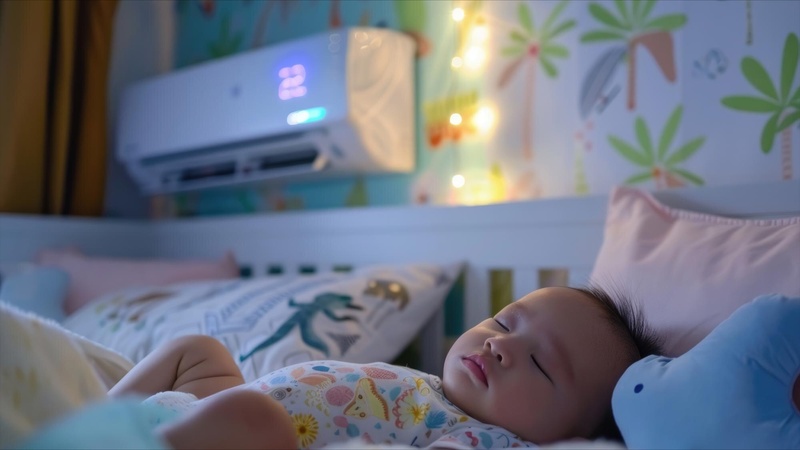
How Hot Is Too Hot for a Baby’s Room?
A baby’s room is too hot when the temperature and sleep conditions prevent the baby from releasing enough body heat to remain comfortable. There is no single room-temperature number that determines overheating in every baby because room temperature works together with clothing, bedding, humidity, airflow, and the baby’s health and age. Parents should therefore use the room temperature as a guide and check the baby directly for signs of overheating.
Temperatures above the recommended sleeping range deserve closer attention, particularly when the baby is swaddled or wearing multiple layers. A warm nursery becomes more likely to cause overheating when heat is trapped around the baby’s body. For example, the same room can create different thermal conditions for a baby wearing lightweight sleepwear and a baby wearing pajamas under a thick sleep sack.
The safest approach is to measure the nursery with a room thermometer rather than relying on how the room feels to an adult. Parents should then consider the reading alongside the baby’s clothing and physical condition. A baby who has a hot or sweaty chest, flushed skin, or other signs of excessive warmth needs attention even when the thermostat does not appear unusually high.
Room temperature also should not be confused with body temperature. A thermometer showing that the nursery is warm indicates an environmental condition; it does not establish that the baby has a fever. Likewise, a fever is a rise in body temperature and can occur even when the nursery itself is comfortably cool.
What Is the Best Room Temperature for a Baby?
The best room temperature for a baby is a comfortably cool temperature that allows the infant to sleep without becoming either overheated or excessively cold. Rather than trying to maintain one exact number throughout every night, parents should aim for a stable sleeping environment and adjust the baby’s clothing when room conditions change.
Recommended temperature ranges can differ between health organizations and safe-sleep guidance, so the final temperature target should follow the pediatric or public-health guidance applicable to the family’s location. The important principle is consistent: the nursery should not be kept unnecessarily warm, and a baby generally does not need a much warmer bedroom than an adult.
A room thermometer provides a more reliable reference than touching the crib, checking the weather forecast, or judging the air by personal comfort. Thermostats can also differ from the temperature around the crib because the thermostat may be located in another room or part of the house. Direct sunlight, an exterior wall, an air-conditioning vent, or poor airflow can further create temperature differences within the nursery.
Parents should combine the room-temperature reading with a physical check of the baby. Clothing can then be reduced or adjusted when the room becomes warmer rather than automatically lowering the thermostat to an unusually cold setting. This approach accounts for both sides of thermal comfort: the temperature of the environment and the amount of heat retained around the baby’s body.
Why Is a Hot Room a Problem for Babies?
A hot room can cause a baby to retain more body heat than the baby can comfortably release. Babies regulate body temperature differently from adults, so their comfort depends not only on the surrounding air but also on clothing, bedding, airflow, humidity, and other sources of retained heat. The risk increases when several heat-retaining factors occur at the same time.
Overheating can occur when heat enters or builds up around the baby faster than the body can release it. For example, a warm nursery combined with thick pajamas and a heavy sleep sack creates a different thermal load from the same nursery with lightweight sleepwear. Swaddling can add another layer around the body, making the overall sleep setup important when parents evaluate whether the room is too warm.
A hot sleep environment is also a safe-sleep concern. Parents should avoid deliberately making the nursery excessively warm or adding extra clothing and bedding because they are worried that the baby might become cold. The goal is not to make the baby feel warm at all times. The goal is to maintain a comfortable environment in which the baby can release excess body heat.
Room temperature should therefore be considered together with the baby’s condition. A number on a thermostat cannot show how much heat is being retained underneath pajamas, a swaddle, or a sleep sack. Parents should use the room temperature as an environmental reference and the baby’s physical signs as a second check.
How Can You Tell If Your Baby Is Too Hot?
Signs that a baby may be too hot include sweating, unusually warm or clammy skin, flushed skin, damp hair, and a chest or back that feels excessively warm. Parents should respond to these signs by checking the sleep environment and reducing unnecessary sources of heat rather than relying only on the thermostat reading.
Sweating is one of the clearest signs that the baby is trying to release excess heat. Damp hair or moist clothing can provide additional evidence that the baby has become too warm. Flushed skin can also occur with excessive warmth, although skin appearance alone should not be used to determine whether a baby is overheating.
Changes in the baby’s general condition also deserve attention. A baby who appears unusually uncomfortable in a hot environment should be checked promptly. Parents can review 3 immediate factors: the room temperature, the amount of clothing or sleepwear, and the baby’s physical warmth. This provides more useful information than assuming that fussiness alone means the nursery is too hot.
Parents should also distinguish overheating from fever. Overheating describes excessive heat related to the baby and the surrounding conditions, while fever refers to an elevated body temperature that may have a medical cause. Cooling the room is therefore not a substitute for appropriate medical assessment when a baby has an abnormal body temperature or concerning symptoms.
Where Should You Check If Your Baby Feels Too Hot?
Check the baby’s chest, back, or torso to assess whether the baby feels excessively warm rather than relying only on the hands and feet. A baby’s extremities can feel cooler than the central part of the body, so cold hands do not automatically mean that the baby needs another layer.
Place a hand gently on the baby’s chest or upper back and check for excessive warmth, sweating, or clamminess. For example, a baby whose hands feel cool but whose back is hot and sweaty should not automatically be given an additional blanket or thicker sleepwear. The condition of the torso provides more useful information about whether the baby is retaining too much heat.
A physical check works best when combined with a nursery thermometer. The thermometer shows what is happening in the environment, while checking the baby helps parents understand how that environment and the current sleepwear are affecting the baby. Together, these two checks provide a more practical basis for deciding whether to remove a layer, adjust the room temperature, or take further action.
What Should a Baby Wear to Sleep in a Hot Room?
A baby should wear lightweight, breathable sleepwear in a hot room, with unnecessary layers removed to reduce heat retention. The appropriate amount of clothing depends on the actual room temperature, the type of sleepwear, and whether the baby is using a sleep sack or swaddle. Parents should assess the complete sleep setup rather than choosing clothing based only on the outdoor temperature.
Adding layers increases the amount of heat retained around the baby’s body. For example, pajamas combined with a sleep sack create more insulation than lightweight pajamas alone. When the nursery becomes warmer, reducing insulation is generally more appropriate than keeping the same sleepwear and relying entirely on a fan or air conditioner to compensate.
Sleep sacks also differ in thermal insulation. Some products use a TOG rating to indicate their relative warmth, with higher TOG values providing more insulation. Parents using a sleep sack should follow the manufacturer’s temperature and clothing guidance for that specific product rather than assuming that every sleep sack provides the same amount of warmth.
Swaddling requires similar attention because wrapping adds material around the baby’s body. Parents should account for the swaddle when evaluating the entire sleep setup and avoid combining a warm room with unnecessary layers underneath it. Swaddling should also follow age-appropriate safe-sleep guidance, including stopping when the baby shows signs of attempting to roll.
The baby’s torso provides a practical check after clothing has been adjusted. If the chest or back remains excessively warm, sweaty, or clammy, reassess the clothing and room conditions instead of assuming that lighter sleepwear has solved the problem. The objective is a comfortably dressed baby, not a baby who feels noticeably warm throughout the night.
How Can You Cool Down a Baby’s Room Safely?
You can cool a baby’s room by reducing heat entering the nursery, improving airflow, using appropriate cooling equipment, removing unnecessary bedding, adjusting sleepwear, and monitoring the actual room temperature. Combining these measures is more effective than relying on a single cooling method when the room becomes particularly hot.
Block direct sunlight during the hottest part of the day with curtains, blinds, or other suitable window coverings. Sunlight entering through a window can continue heating the nursery even when the rest of the home feels comfortable. Reducing this heat before bedtime can make the room easier to cool later.
Improve ventilation when outdoor conditions make it appropriate. Air movement can help prevent warm air from remaining trapped in the nursery. A fan can also circulate air, while air conditioning can lower the room temperature when passive measures are insufficient. Cooling equipment should be arranged so that the baby is not exposed to an unnecessarily strong stream of cold air.
Reduce heat retained around the baby at the same time. Heavy sleepwear, unnecessary layers, thick sleep sacks, and additional bedding can continue trapping body heat even after the room begins cooling. Cooling the nursery and adjusting the baby’s clothing should therefore be treated as connected actions.
Monitor the room with a thermometer after making changes. A thermostat setting does not always represent the temperature around the crib, particularly when the thermostat is located elsewhere in the home. Checking the nursery itself helps parents determine whether curtains, ventilation, a fan, or air conditioning have actually changed the sleeping environment.
Finally, check the baby rather than stopping at the room-temperature reading. Feel the chest or back for excessive warmth, sweating, or clamminess and reassess the sleepwear when necessary. This creates a practical sequence for managing a hot nursery: reduce incoming heat, improve cooling, adjust insulation, measure the room, and check the baby.
Can You Use a Fan in a Baby’s Room?
You can use a fan in a baby’s room to improve air circulation and make a warm nursery more comfortable. A fan moves air around the room, but it should not be treated as a substitute for monitoring the actual room temperature or checking whether the baby is overheating.
Fan placement matters because the goal is to circulate air throughout the nursery rather than create a strong stream of air directed continuously at the baby. Position the fan at a safe distance from the crib and keep electrical cords completely outside the baby’s reach. The fan itself should also be placed where it cannot be pulled over or accessed as the baby becomes more mobile.
A fan does not necessarily lower the actual temperature of a room. Instead, it primarily moves air and can improve circulation. For example, a nursery can remain hot even when a fan is running if direct afternoon sunlight continues heating the room. In that situation, blocking sunlight or using air conditioning may be necessary to reduce the room temperature itself.
Parents should continue checking both the room and the baby while using a fan. Use a room thermometer to monitor the nursery and check the baby’s chest or back for excessive warmth, sweating, or clamminess. Clothing and sleepwear may still need to be reduced when the room remains warm.
Is Air Conditioning Safe for a Baby’s Room?
Air conditioning can be used in a baby’s room to maintain a comfortable temperature during hot weather. The objective is to prevent the nursery from becoming excessively hot without making the baby unnecessarily cold. Parents should therefore use air conditioning as a temperature-control method rather than trying to create the coldest possible sleeping environment.
The thermostat setting and the temperature around the crib are not always identical. An air-conditioning thermostat may be located in another room, while sunlight, room size, insulation, and the location of air vents can create temperature differences within the nursery. A separate room thermometer near the baby’s sleep area provides a more useful measurement of the actual environment.
Airflow also matters. Avoid positioning the crib where a strong stream of cold air from an air-conditioning vent blows continuously toward the baby. The purpose of air conditioning is to regulate the overall room temperature, not to cool the baby directly with concentrated cold airflow.
Baby sleepwear should be adjusted after the room temperature changes. Do not keep a baby in clothing selected for a hot room after air conditioning has substantially cooled the nursery. Likewise, there is no need to compensate for air conditioning automatically by adding several layers. Check the room temperature first and select sleepwear appropriate for the resulting conditions.
Air conditioning works best as part of a complete temperature-management approach. Parents can reduce direct sunlight during the day, use the air conditioner when necessary, monitor the nursery with a thermometer, choose appropriate sleepwear, and check the baby’s torso before and during sleep. These steps address both the environmental temperature and the amount of body heat the baby retains.
Does Humidity Affect How Hot a Baby’s Room Feels?
Humidity can affect how warm and uncomfortable a baby’s room feels because high humidity makes it harder for moisture to evaporate from the skin. Room temperature and relative humidity measure different environmental conditions, so a temperature reading alone does not describe the entire thermal environment around a baby.
High humidity becomes particularly relevant during hot weather. When the surrounding air already contains a high amount of moisture, evaporation becomes less effective as a cooling mechanism. A warm, humid nursery can therefore require more attention than a room at the same temperature with lower humidity, especially when the baby is also wearing insulating sleepwear.
Parents can monitor humidity with a hygrometer or a combined thermometer and hygrometer when humid conditions are common in the home. The measurement should be considered alongside the room temperature and the baby’s condition rather than treated as an independent target. For example, sweating or a hot, clammy torso indicates that the baby’s overall sleep setup needs to be reassessed even if the temperature reading has not changed substantially.
Air conditioning can reduce both heat and indoor humidity in some environments, while ventilation may help when outdoor air is cooler and less humid. The appropriate method depends on the conditions inside and outside the home. The practical goal is to maintain a comfortable sleep environment rather than trying to achieve one exact humidity reading regardless of temperature.
Should You Change Your Baby’s Room Temperature in Summer?
Parents should manage a baby’s room more actively in summer when outdoor heat, direct sunlight, and warm indoor air cause the nursery temperature to rise. The safe-sleep goal itself does not change with the season: keep the baby comfortably cool, avoid overheating, and adjust the sleep setup according to the actual conditions in the room.
Start managing heat before bedtime rather than waiting until the nursery has already become excessively warm. Closing curtains or blinds before direct sunlight reaches the windows can reduce solar heat entering the room. Ventilation can also help when the outdoor air is cooler than the indoor air, particularly during the evening or early morning.
Use a fan or air conditioning when passive cooling is not enough. A fan can improve air circulation, while air conditioning can reduce the room temperature directly. Parents should continue measuring the nursery because the weather forecast and outdoor temperature do not show how hot the baby’s actual sleeping area has become.
Summer also requires adjustments to clothing. Reduce unnecessary insulation when the room becomes warmer instead of keeping winter sleepwear and trying to compensate entirely with cooling equipment. Lightweight sleepwear or an appropriately rated sleep sack may be more suitable than multiple layers, depending on the room temperature and the product guidance.
Daytime and nighttime conditions can differ significantly during hot weather. A nursery heated by afternoon sunlight may remain warm after sunset, while an air-conditioned room may become progressively cooler overnight. Checking the room temperature at bedtime and again when conditions change helps parents make better clothing and cooling decisions.
Heat waves require closer monitoring because indoor temperatures can remain elevated for prolonged periods. During these conditions, parents should combine several measures: block incoming sunlight, improve airflow, use appropriate cooling equipment, reduce unnecessary clothing layers, monitor the nursery, and check the baby directly. The baby’s chest or back should feel comfortably warm rather than hot, sweaty, or clammy.
When Should You Get Medical Help If Your Baby Is Too Hot?
Get medical help when a baby exposed to heat develops concerning physical symptoms rather than assuming that cooling the room alone will solve the problem. A warm nursery is an environmental issue that parents can often address by changing clothing and cooling the room, while abnormal body temperature or significant changes in the baby’s condition can require medical assessment.
Parents should pay particular attention when excessive warmth occurs alongside symptoms such as unusual lethargy, difficulty waking, abnormal breathing, poor feeding, repeated vomiting, or other significant changes from the baby’s normal behavior. These signs should not be explained solely by a high room-temperature reading. The baby’s physical condition is more important than the thermostat when deciding whether the situation has moved beyond ordinary temperature management.
Fever also needs to be distinguished from a hot nursery. A high room temperature and an elevated body temperature are not the same measurement. Room thermometers measure the surrounding air, whereas a suitable body thermometer measures the baby’s temperature. Moving a baby into a cooler room does not replace appropriate medical guidance when the baby has a fever or appears unwell.
Age is especially important when evaluating an abnormal body temperature. Young infants require more cautious assessment than older children, so parents should follow pediatric guidance for their baby’s age rather than waiting for the nursery to cool and checking again much later. Seek urgent medical assistance when a baby has severe symptoms, has difficulty breathing, is unusually difficult to wake, or appears seriously unwell.
What Should You Do If Your Baby’s Room Is Too Hot at Night?
If your baby’s room is too hot at night, check the room temperature, check the baby for overheating, reduce unnecessary clothing, improve cooling, and reassess the baby after making changes. This sequence addresses both sources of excessive warmth: heat in the nursery and heat retained around the baby’s body.
First, check the actual room temperature with a thermometer. Do not rely only on the outdoor temperature, thermostat setting, or how the nursery feels when you enter it. A room can remain warm after a hot day because walls, windows, and furnishings have retained heat, while an air-conditioned nursery may become cooler as the night progresses.
Second, check the baby’s chest or back for excessive warmth, sweating, or clamminess. These areas provide more useful information than hands and feet when assessing whether the baby feels too hot. Also observe the baby’s general condition rather than using room temperature as the only indicator.
Third, remove unnecessary insulation. Adjust pajamas, sleepwear, or the sleep sack according to the current room conditions and the guidance for the specific sleep product. Avoid adding loose bedding as a way to manage changing temperatures during the night.
Fourth, improve the environment. Use curtains or blinds to limit retained or incoming heat where relevant, improve airflow, run a safely positioned fan, or use air conditioning when necessary. Cooling should target the overall sleep environment rather than directing an intense stream of cold air at the baby.
Finally, reassess both the nursery and the baby. Check whether the room temperature is changing and whether the baby’s chest or back feels more comfortable after clothing and cooling adjustments. Seek medical advice rather than continuing to make environmental changes when the baby has an abnormal body temperature, concerning symptoms, or appears unwell.
For most parents, the practical rule is simple: measure the room, check the baby, adjust the layers, cool the environment, and check again. This approach is more reliable than treating one thermostat number as the only measure of whether a baby’s room is too hot.