
The best educational games for toddler brain development include simple puzzles, sorting and matching games, building blocks, pretend play, hide-and-find activities, music and movement games, and cause-and-effect games. These activities give toddlers repeated opportunities to solve problems, remember information, recognize patterns, use language, coordinate movements, and understand how their actions produce results.
Different games support different developmental skills. Simple puzzles encourage toddlers to compare shapes and test possible solutions, while matching games require them to remember and recognize visual information. Building blocks introduce spatial relationships, balance, and cause and effect. Pretend play creates opportunities to practice vocabulary, sequencing, and symbolic thinking through familiar situations such as cooking, shopping, or caring for a doll.
The right game also depends on a toddler’s developmental stage. A 1-year-old may benefit more from stacking and object-permanence games, while 2- and 3-year-olds can engage with increasingly complex puzzles, sorting activities, memory games, and pretend play. This guide covers the best educational games for toddlers, the skills each activity develops, age-appropriate options, and practical ways parents can turn everyday play into learning opportunities.
What Are the Best Educational Games for Toddler Brain Development?
There are 10 educational games that are especially useful for toddler brain development: simple puzzles, sorting games, matching games, building blocks, pretend play, hide-and-find games, music and movement games, cause-and-effect games, picture and naming games, and simple counting games. Each activity creates a different learning challenge, so toddlers practice multiple cognitive skills through play rather than repeating one type of task.
Simple puzzles develop problem-solving and spatial thinking by requiring toddlers to determine where individual pieces belong. A toddler first observes the shape or picture, compares it with available spaces, tries a position, and adjusts the piece when it does not fit. This trial-and-error process connects visual information with physical action. Large-piece animal, vehicle, and shape puzzles are practical starting points because toddlers can identify familiar objects while practicing hand-eye coordination.
Sorting games develop classification and pattern-recognition skills by teaching toddlers to identify similarities and differences between objects. Parents can ask a child to separate red and blue blocks, group toy animals by type, or sort household objects by size. The child must observe an attribute, compare objects, and apply the same rule repeatedly. As the activity becomes easier, parents can change the sorting rule from color to shape, size, or function to create a new cognitive challenge.
Matching games strengthen recognition, attention, and memory by requiring toddlers to connect related pieces of information. A simple activity might involve matching two identical animal pictures, pairing colored objects, or finding an object that corresponds to a picture card. Toddlers must retain information long enough to compare one item with another. Parents can begin with two or three obvious pairs and gradually add more choices as the child becomes familiar with the task.
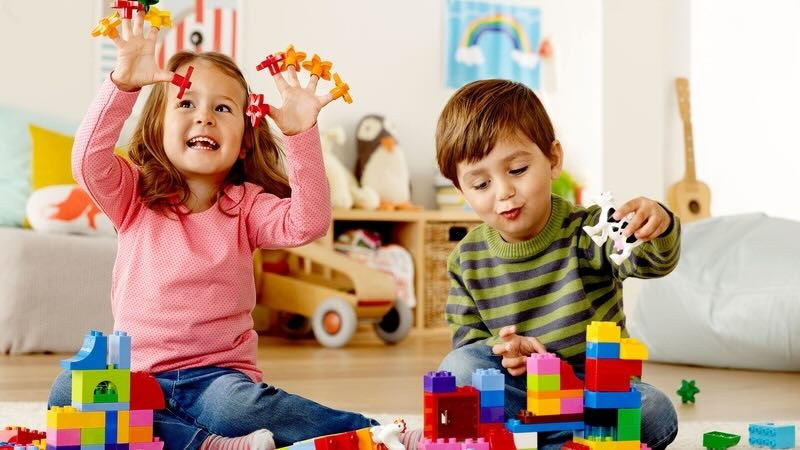
Building blocks develop spatial thinking, problem-solving, and an early understanding of cause and effect. When toddlers stack blocks, they learn that position, size, and balance affect whether a structure remains standing. A block placed too far from the center can make a tower fall, while a wider base provides more room for additional blocks. Instead of correcting every unsuccessful attempt, parents can allow toddlers to rebuild structures and discover which arrangements work through repeated experimentation.
Pretend play develops language, sequencing, and symbolic thinking by allowing toddlers to represent familiar experiences through play. A toy banana can become food in a pretend kitchen, a cardboard box can become a car, and a doll can become a patient during a doctor game. These activities require children to connect objects with ideas and organize actions into simple sequences. For example, a pretend grocery game can involve choosing food, naming each item, placing it in a basket, paying for it, and putting it away.
Hide-and-find games exercise attention and memory because toddlers must remember information that is no longer immediately visible. Parents can place a favorite toy under one of two cups, move the cups slowly, and ask the toddler to find the toy. Another version involves showing three familiar objects, hiding one, and asking which object disappeared. The difficulty can increase gradually by adding more hiding locations or objects instead of making the activity complicated from the beginning.
Music and movement games combine listening, memory, imitation, and physical coordination. Activities such as copying a simple clap pattern, performing movements mentioned in a song, or stopping when music stops require toddlers to listen for a signal and respond with an appropriate action. Repeating the same songs also gives children opportunities to anticipate familiar words, rhythms, and movements. Parents can make the activity more challenging by introducing two-step sequences such as “clap, then jump.”
Cause-and-effect games teach toddlers that specific actions produce observable results. Rolling a ball down a ramp, pressing a button to activate a toy, dropping objects into containers, or knocking down a block tower allows the child to connect an action with its consequence. Repetition is useful because the toddler can test whether the same action produces the same outcome. Parents can extend the activity by changing one element, such as using a steeper ramp and observing how the ball moves differently.
Picture and naming games support vocabulary, recognition, and memory by connecting spoken words with visual information. Parents can use picture books, family photographs, animal cards, or familiar household objects and ask the toddler to identify what they see. The activity can progress from “Where is the dog?” to “What is the dog doing?” as the child’s language develops. This changes the task from simple recognition to describing actions and relationships.
Simple counting games introduce toddlers to quantities and number words through physical objects. Parents can count three blocks while stacking them, place two toy cars in a box, or count pieces of fruit during snack preparation. The purpose at this stage is not formal arithmetic. The activity connects spoken number words with visible quantities and repeated actions, making early numerical concepts part of everyday play.
The most useful educational game is therefore not necessarily the most complicated one. A strong toddler learning activity gives the child a clear task, an observable result, opportunities for repetition, and an appropriate level of challenge. Parents can use puzzles for problem-solving, matching games for memory, blocks for spatial thinking, pretend play for language, and movement games for listening and coordination. Rotating these activities exposes toddlers to different learning demands while keeping play varied and engaging.
Which Educational Games Develop the Most Important Toddler Cognitive Skills?
The most useful educational games for toddler cognitive development target 6 core skills: problem-solving, memory, attention, language, spatial thinking, and fine motor coordination. Puzzles and shape sorters are particularly useful for problem-solving, matching and hide-and-find games exercise memory, picture-search activities require attention, pretend play supports language, building blocks develop spatial thinking, and hands-on manipulation strengthens fine motor coordination. Parents can select games according to the skill a toddler is ready to practice rather than expecting one activity to develop every area equally.
| Developmental skill | Educational games | Example activity |
|---|---|---|
| Problem-solving | Puzzles, blocks, shape sorters | Find where a puzzle piece fits |
| Memory | Matching, hide-and-find games | Remember which cup hides a toy |
| Attention | Puzzles, picture-search games | Find a named object in a picture |
| Language | Pretend play, naming games | Name foods in a pretend kitchen |
| Spatial thinking | Blocks, puzzles | Build and balance a block tower |
| Fine motor coordination | Blocks, peg games, shape sorters | Pick up and place objects accurately |
Problem-solving games teach toddlers to identify a goal, try a solution, observe the result, and make another attempt when necessary. A shape sorter provides a clear example: the child has an object that must fit into one opening, but several openings are available. Turning the shape, comparing openings, and trying again after an unsuccessful attempt creates a simple problem-solving cycle. Puzzles and building activities use the same mechanism with different levels of complexity.
Memory games require toddlers to retain and retrieve information during an activity. Matching pictures asks a child to remember previously seen images, while hide-and-find activities require the child to remember the location of an object after it disappears from view. Parents can control difficulty by changing the amount of information involved. Finding a toy under one of two cups creates a simpler memory demand than remembering the positions of several picture cards.
Attention games encourage toddlers to focus on relevant information while ignoring competing objects or distractions. Picture-search games demonstrate this clearly. When a parent asks, “Where is the yellow duck?” on a page containing several animals, the toddler must listen to the request, visually scan the page, distinguish the target from other pictures, and indicate the correct object. Simple puzzles and sorting activities create similar demands because the child must remain focused long enough to complete a specific task.
Language games build connections between objects, actions, and spoken words. Pretend play is especially useful because vocabulary appears within a meaningful situation rather than as isolated words. During a pretend kitchen game, a toddler can hear and use words for foods, utensils, actions, colors, and quantities. Parents can extend the activity with short questions such as “What are you cooking?” or “Where does the spoon go?” instead of turning play into a formal vocabulary lesson.
Spatial-thinking games help toddlers understand how objects relate to one another in space. Building blocks require children to work with concepts such as above, below, beside, inside, outside, bigger, and smaller through physical manipulation. A toddler who tries to balance a large block on a smaller one receives immediate visual and physical feedback when the structure falls. Rebuilding the tower allows the child to test a different arrangement and compare the outcome.
Fine motor games develop controlled hand and finger movements that allow toddlers to manipulate objects more precisely. Picking up blocks, turning puzzle pieces, placing shapes into openings, and inserting large pegs all require visual information to guide physical movement. These activities combine hand-eye coordination with cognitive decisions about where an object belongs. A shape sorter, for example, requires the toddler both to identify the correct opening and to rotate and position the shape accurately enough to insert it.
Parents do not need to isolate these 6 skills into separate learning sessions. One well-designed game can involve several developmental processes at the same time. Completing a simple puzzle can combine attention, problem-solving, spatial thinking, visual recognition, and fine motor coordination. The primary skill describes the game’s main cognitive demand, while secondary skills develop through the actions required to complete it.
What Educational Games Are Best for 1-, 2-, and 3-Year-Old Toddlers?
The best educational games for 1-, 2-, and 3-year-old toddlers become progressively more complex as children develop stronger memory, language, coordination, and problem-solving skills. One-year-olds benefit from simple activities involving objects, repetition, and cause and effect. Two-year-olds can handle basic puzzles, sorting, matching, and pretend play. Three-year-olds are ready for activities involving longer sequences, memory, patterns, counting, and more detailed role-play. Age is a useful starting point rather than a strict rule because toddlers develop individual skills at different rates.
What Educational Games Are Best for 1-Year-Old Toddlers?
The best educational games for 1-year-old toddlers include object-permanence games, stacking activities, simple cause-and-effect games, naming games, and container play. These activities work well because they provide an immediate connection between the child’s action and a visible or audible result. A toddler can drop a block into a container, stack one object on another, uncover a hidden toy, or push an object and watch it move.
Object-permanence games can be as simple as partially hiding a familiar toy under a cloth and encouraging the toddler to find it. The activity teaches the child to search for an object even when it is no longer fully visible. Parents can increase the challenge gradually by hiding the entire toy or offering two possible hiding locations once the simpler version becomes easy.
Stacking and container games add spatial and fine motor challenges. A toddler can place large blocks on top of one another, put safe objects into a container, remove them, and repeat the sequence. The repeated actions provide information about size, position, balance, and physical relationships. Parents can reinforce language naturally by using words such as “in,” “out,” “up,” “down,” “big,” and “small” while the child plays.
What Educational Games Are Best for 2-Year-Old Toddlers?
The best educational games for 2-year-old toddlers include simple puzzles, shape and color sorting, matching activities, building blocks, pretend play, and music-and-movement games. These games introduce rules and goals while still allowing children to learn through physical exploration and repetition.
A simple puzzle asks a 2-year-old to compare a piece with possible locations and change the approach when the first attempt fails. Sorting adds another cognitive demand because the child must identify a shared characteristic. Parents might provide several red and blue blocks and ask the toddler to place each color into a different container. Once color sorting becomes familiar, the same activity can use shapes or sizes to introduce a new classification rule.
Pretend play becomes especially useful as toddlers begin representing familiar routines through objects and actions. A child might pretend to feed a doll, cook with toy food, talk on a toy phone, or put a stuffed animal to bed. Parents can participate by naming objects and describing actions, but the child should still have room to direct the activity. A pretend meal, for example, can combine vocabulary, sequencing, imitation, and social interaction within one game.
Music and movement activities give 2-year-olds another way to practice listening and responding to instructions. A parent can ask the toddler to clap, stomp, turn around, or stop when the music stops. Starting with one action keeps the task manageable. Two actions can be combined later when the child consistently follows the simpler instruction.
What Educational Games Are Best for 3-Year-Old Toddlers?
The best educational games for 3-year-old toddlers include memory matching, multi-piece puzzles, pattern games, role-playing, simple counting activities, and sequencing games. These activities require children to hold more information in mind, follow longer sequences, recognize relationships, or apply a rule across several actions.
Memory matching can begin with a small number of picture pairs placed face down. The child turns over two cards and tries to find matching images. When the cards do not match, remembering their locations provides information for later turns. Parents can begin with a few pairs and increase the number after the toddler understands the rules instead of starting with a large deck.
Pattern and sequencing games introduce relationships between multiple objects or events. A parent can arrange blocks in a simple red-blue-red-blue sequence and encourage the child to continue it. Sequencing can also use familiar daily routines. Pictures showing washing hands, eating, and cleaning up can be arranged in order, allowing the child to think about what happens first, next, and last.
Role-playing expands pretend play by introducing longer scenarios and multiple actions. A pretend grocery store can involve selecting an item, naming it, placing it in a basket, paying for it, and taking it home. A doctor game can involve greeting a patient, checking a stuffed animal, describing the problem, and providing pretend treatment. These scenarios combine language, memory, sequencing, symbolic thinking, and social interaction.
Simple counting games can also become part of ordinary play at this age. A child can count three toy cars before placing them in a box or give two pretend apples to a stuffed animal. Using physical objects helps connect number words with quantities instead of requiring toddlers to memorize a number sequence without context.
The appropriate game is determined by both age and the child’s current ability. An activity is most useful when the toddler can understand its basic goal but still needs to think, experiment, remember, or practice to complete it. Parents can simplify a difficult game by reducing the number of pieces, choices, or steps, and increase difficulty once the child completes the activity consistently.
How Can Parents Turn Everyday Activities Into Educational Games?
Parents can turn everyday activities into educational games by adding a simple learning goal to familiar routines such as sorting laundry, putting away toys, reading books, preparing snacks, and pretend shopping. These activities do not require specialized educational toys because common household objects already provide opportunities to compare, classify, remember, count, name, and sequence information. The key is to give the toddler one clear task that matches their current ability.
Sorting laundry is a practical classification game. Parents can place several pairs of socks in front of a toddler and ask the child to find two that look the same. A simpler version uses socks in two clearly different colors, while a more challenging version includes similar colors, patterns, or sizes. The child must observe visual features, compare objects, and decide which items belong together. The same mechanism can be used when sorting toys into cars and animals or separating large blocks from small blocks.
Putting away toys can become a sorting and memory activity rather than only a cleanup routine. A parent might ask the toddler to place blocks in one container and toy animals in another. Once the child understands the categories, the parent can introduce a different rule, such as sorting objects by color. Changing the rule encourages the toddler to examine the same objects from a different perspective instead of memorizing only one correct location.
Parents can create a memory game with 3–5 familiar household objects. Place items such as a spoon, cup, toy car, and ball where the toddler can see them, name each object together, and then cover or remove one item. Ask the child which object is missing. This activity requires the toddler to pay attention to the original group, retain information about the objects, and retrieve that information after one disappears. Begin with fewer objects and add another item when the child can complete the easier version consistently.
Pretend grocery shopping turns a familiar routine into a multi-step learning game. Parents can arrange safe toy foods or household items and ask the toddler to find specific objects, place them in a basket, pretend to pay, and put the purchases away. Each step creates a different cognitive demand. Finding an apple practices recognition, separating fruits from other items practices classification, and completing the shopping sequence exercises memory and ordering. Parents can also introduce language naturally with questions such as “Which fruit do we need?” or “Where should the milk go?”
Snack preparation can introduce counting, comparison, and simple instructions. A parent can ask a toddler to put two crackers on a plate, choose the bigger banana, or place three pieces of fruit into a bowl. The toddler connects words such as “two,” “three,” “bigger,” and “smaller” with visible objects and physical actions. Using quantities within a meaningful activity gives number words a concrete reference instead of treating counting as an isolated recitation exercise.
Books can become interactive educational games when toddlers are asked to search, identify, remember, and predict rather than only listen. A parent can begin with “Where is the cat?” to encourage visual searching and object recognition. “What is the cat doing?” adds vocabulary and action recognition. With a familiar story, asking “What happens next?” introduces recall and prediction. The same book can therefore provide different cognitive challenges as the child’s language and attention develop.
Daily routines can also become sequencing games. During handwashing, for example, parents can describe a short sequence: turn on the water, wet the hands, use soap, rinse, and dry. Once the routine becomes familiar, the toddler can be asked what comes next. Dressing, preparing for bed, cleaning up toys, and setting the table provide similar opportunities to practice ordering familiar actions.
An everyday activity becomes educational when the toddler has something specific to notice, remember, compare, solve, or communicate. Parents do not need to add questions to every moment or turn ordinary play into a lesson. A single prompt such as “Can you find the matching sock?” or “Which toy is missing?” is enough to introduce a cognitive task while keeping the activity playful and familiar.
How Long Should Toddlers Play Educational Games Each Day?
Toddlers do not need a fixed daily amount of structured educational game time to benefit from learning through play. Educational games work best as part of a broader day that includes free play, physical movement, conversation, books, meals, daily routines, and interaction with caregivers. Instead of trying to make a toddler complete a predetermined number of minutes, parents can pay attention to whether the child remains engaged with the activity.
A learning game can end when the toddler repeatedly walks away, stops responding to the activity, becomes frustrated, or begins using the materials for a completely different purpose. Continuing after these signals can turn a playful cognitive challenge into an unwanted task. For example, a toddler who completes a simple puzzle several times and then starts throwing the pieces is unlikely to gain more from being asked to finish it again. Switching to blocks, movement, pretend play, or free exploration changes the cognitive demand without requiring the child to remain focused on the same activity.
Parents can also divide educational play across ordinary routines instead of creating one long learning session. A toddler might spend a few minutes matching socks in the morning, count pieces of fruit during a snack, complete a puzzle later in the day, and practice naming animals while reading before bed. Each activity targets a different skill while remaining connected to a familiar context.
The quality and appropriateness of the activity matter more than extending its duration. A game should provide enough challenge for the toddler to observe, remember, compare, communicate, or solve a problem without creating repeated frustration. When an activity becomes consistently easy, parents can increase its difficulty by adding another puzzle piece, sorting category, matching pair, instruction, or step rather than simply asking the child to play for longer.
Should Parents Play Educational Games With Their Toddlers?
Parents should participate in toddler educational games when their involvement helps the child understand the activity, learn new language, solve a manageable problem, or progress to a more difficult task. Parent participation is especially useful when introducing a new game because toddlers can observe how an activity works before attempting it themselves. However, parents do not need to direct every action because independent exploration also gives toddlers opportunities to test ideas and discover solutions.
Guided play combines a child’s active participation with limited support from an adult. For example, a parent introducing a shape sorter can demonstrate one piece and then allow the toddler to attempt the remaining shapes. If the child struggles, the parent can provide a clue such as rotating the shape or pointing to two possible openings rather than immediately inserting the piece. This approach keeps the problem with the child while reducing unnecessary frustration.
Parent-child play also creates opportunities for language development. Building a block tower can include words such as “above,” “under,” “tall,” “small,” “fall,” and “again.” Pretend cooking can introduce names for foods, utensils, actions, colors, and quantities. Language becomes connected to objects and actions the toddler can see, which gives the words an immediate context.
Questions are most useful when they extend the activity rather than constantly test the child. A parent can ask “Where could this piece go?” during a puzzle or “What should we buy next?” during pretend shopping. Asking a question after every action can interrupt the child’s concentration and shift control of the activity away from the toddler. Comments such as “You put the big block underneath” can provide useful language without requiring an answer.
Independent play serves a different purpose. When toddlers manipulate blocks, puzzles, containers, or other age-appropriate materials without continuous adult direction, they make their own decisions about what to try next. A block tower that falls, for example, provides immediate feedback. The toddler can rebuild it differently without a parent supplying the solution.
A useful balance is to provide support when it adds learning value and reduce support when the toddler can continue independently. Parents can introduce the game, demonstrate an unfamiliar action, add relevant language, and help when frustration prevents progress. They can then allow the child to repeat, experiment, make mistakes, and discover solutions. This balance preserves the educational value of guided interaction without turning play into a parent-controlled lesson.
Are Screen-Free Games Better Than Educational Apps for Toddlers?
Screen-free games provide toddlers with more opportunities to physically manipulate objects, move their bodies, interact directly with caregivers, and receive sensory feedback from the environment. Activities such as puzzles, building blocks, sorting objects, pretend play, and movement games require toddlers to perform actions in the physical world and observe their consequences. Educational apps can provide interactive learning experiences, but touching or dragging an object on a screen creates a different experience from rotating a puzzle piece, balancing a block, or sorting physical objects by size and shape.
Physical manipulation is particularly relevant when a game combines cognitive and fine motor demands. A toddler completing a wooden puzzle must identify the correct location, rotate the piece, control hand movement, and position the piece accurately. A building activity adds information about weight, balance, position, and gravity because the toddler can physically feel and observe what happens when blocks are arranged differently.
Screen-free activities also make parent-child interaction easy to integrate into the game. During pretend play, parents can respond to what the toddler says, introduce new vocabulary, imitate actions, and expand a simple scenario. A pretend tea party, for example, can progress from naming a cup to pouring pretend tea, serving another person, counting cups, and following a sequence of actions. The activity changes in response to the child’s behavior rather than following only predetermined interactions.
Educational apps can still introduce toddlers to pictures, sounds, matching tasks, simple vocabulary, and cause-and-effect interactions. However, an app should not be considered educational solely because it is marketed for children. Parents should examine what the toddler actually does during the activity. A game that requires the child to make a choice, remember information, recognize a relationship, or solve a simple problem creates a clearer cognitive task than an app based mainly on passive viewing or repetitive tapping.
Parents do not need to choose exclusively between screen-free games and educational apps. The more useful question is what type of learning experience a particular activity provides. Screen-free play is especially valuable when the goal involves physical manipulation, movement, sensory exploration, or direct social interaction. Digital activities should be evaluated according to the specific cognitive task they ask the toddler to perform rather than the “educational” label alone.
How Do You Choose the Right Educational Game for Your Toddler?
Choose an educational game by evaluating 7 factors: developmental stage, target skill, difficulty, attention requirement, safety, the child’s interests, and replay value. A suitable game should give the toddler a clear goal and enough challenge to require thinking or practice without making successful participation consistently impossible.
Developmental stage determines whether the basic demands of a game match what the child can currently do. A 1-year-old who is exploring how objects move and fit into containers needs a different challenge from a 3-year-old who can remember several picture locations or follow a short sequence. Age recommendations can provide a starting point, but parents can also observe whether their child understands the basic objective of the activity.
Target skill determines why a particular game belongs in the toddler’s play routine. Choose puzzles and shape sorters when the goal is problem-solving, matching games when the goal is memory, blocks when the goal is spatial thinking, and pretend play when the goal includes language and symbolic thinking. Selecting activities this way creates variety across developmental skills instead of buying several games that require essentially the same action.
Difficulty should sit between immediate success and repeated failure. A puzzle that a toddler completes without looking closely provides little new challenge, while a puzzle that remains impossible after repeated attempts can produce frustration. Parents can adjust difficulty without replacing the entire game. Reduce the number of puzzle pieces, matching cards, or sorting choices to make an activity easier; add more pieces, categories, or steps when the toddler consistently succeeds.
Attention requirement should match the child’s ability to remain engaged with the task. Games with several rules or long sequences demand more sustained attention than stacking blocks or placing shapes into openings. A toddler who leaves an activity quickly may need a simpler version rather than more encouragement to remain seated. Parents can increase complexity gradually as the child becomes comfortable with the game’s basic structure.
Safety is a non-negotiable selection criterion for toddler games. Materials should be appropriate for the child’s age and physical abilities, particularly when an activity includes pieces that can be detached, lifted, thrown, or placed in the mouth. Parents should also consider whether a game requires direct supervision before allowing independent play.
A child’s interests can make repeated practice easier to sustain. A toddler interested in animals may engage longer with an animal matching game than with abstract picture cards. A child fascinated by vehicles may prefer counting toy cars, completing vehicle puzzles, or sorting cars by color. The cognitive task can remain the same while the theme changes to match what captures the child’s attention.
Replay value determines whether a game can create new challenges as the toddler develops. Building blocks have high replay value because the same materials can be stacked, sorted, counted, used to create patterns, or incorporated into pretend play. Picture cards can progress from simple naming to matching, memory, classification, and storytelling activities. Games that support several levels of difficulty can remain useful after the toddler masters the first task.
The right educational game should make the toddler an active participant rather than a passive observer. Look for activities that require the child to choose, compare, remember, manipulate, communicate, predict, or solve. These actions reveal what the child is practicing and make it easier for parents to match each game with a specific developmental goal.
What Safety Features Should Parents Check in Toddler Educational Games?
Parents should check 6 safety factors when choosing educational games for toddlers: small parts, sharp or damaged components, material condition, age suitability, physical stability, and supervision requirements. A game only provides developmental value when a toddler can interact with it safely, so safety should be evaluated before difficulty, educational features, or entertainment value.
Small detachable pieces require particular attention because toddlers frequently explore objects with their mouths. Games designed around matching, sorting, building, or counting may contain individual pieces that are appropriate for older children but unsuitable for younger toddlers. Parents should inspect the complete game rather than assuming every component is safe because the main toy appears large. Loose buttons, detachable decorations, broken puzzle pieces, and other small components should be removed from a toddler’s play area when they present a hazard.
Parents should also inspect educational toys for sharp edges, cracks, splinters, and damaged components before play. Repeated use can change the condition of a toy that was originally suitable. A cracked plastic shape, damaged wooden block, or loose component can create a different safety risk from the intact product. Regular inspection is particularly useful for frequently used puzzles, blocks, shape sorters, and toys shared between siblings.
Age suitability helps parents evaluate whether the size, design, and intended method of play are appropriate for the child. It should also be considered alongside the toddler’s actual behavior. A child who still frequently puts play materials in their mouth requires different supervision from a child who reliably uses the same materials only for their intended activity.
Physical stability matters when an educational game involves climbing, pushing, pulling, or large moving objects. The learning objective does not eliminate the physical demands of the activity. Parents should consider where the game is played, what happens if the toddler loses balance, and whether nearby furniture or objects introduce additional hazards.
Supervision requirements depend on both the materials and the activity. A toddler may be able to play independently with large blocks in a safe space while another activity requires an adult nearby because it contains multiple pieces or involves household objects. Everyday educational games also require parents to distinguish between objects that are convenient for an activity and objects that are genuinely appropriate for toddler play.
The safest educational game matches both the toddler’s developmental ability and the way the child actually interacts with its materials. Parents should check the game before play, remove damaged or unsuitable components, follow relevant age and safety guidance, and provide direct supervision when the activity requires it. These checks allow toddlers to explore, experiment, and solve problems without making the educational goal more important than physical safety.