
A 2-year-old is roughly 2 feet 10 inches to 2 feet 11 inches tall, although average height differs slightly between boys and girls. At this age, a few inches of difference between toddlers is expected because children do not all grow at exactly the same rate.
Height at age 2 is better interpreted with a growth chart than against a single “ideal” number. The World Health Organization (WHO) provides separate length- and height-for-age standards for boys and girls from birth through age 5, including percentile charts that show how a child’s measurement compares with children of the same age and sex.
For parents, the most useful information is not simply whether a 2-year-old is taller or shorter than average. A child’s growth pattern over time provides more context because height measurements can be tracked across routine checkups to see how the child progresses along a growth curve. WHO specifically identifies height and weight tracking as part of monitoring growth in infants and young children.
This guide explains how tall 2-year-olds are in feet, the average heights for boys and girls, how height percentiles work, how to measure a toddler accurately, and which factors influence growth.
How Tall Are 2-Year-Olds in Feet?
A typical 2-year-old is about 2 feet 9 inches to 2 feet 10 inches tall. The exact measurement differs by sex, age in months, and the growth standard used. At age 2, even a difference of one or two inches can represent a substantial difference in height percentile, so parents should compare measurements using an age- and sex-specific growth chart rather than treating one average as the required height.
The World Health Organization (WHO) provides separate height-for-age standards for boys and girls from ages 2 to 5. These charts compare a child’s standing height with children of the same age and sex and display the distribution using percentiles. WHO’s standards cover children from birth through age 5 and were developed to describe growth under optimal environmental conditions.
For parents who measure height in the U.S. customary system, feet and inches are usually easier to visualize than centimeters. For example, 34 inches equals 2 feet 10 inches, while 36 inches equals exactly 3 feet. Pediatric growth charts commonly use centimeters, however, so keeping both measurements makes it easier to compare a home measurement with a growth chart.
| Child | Approximate Height | Height in Inches | Height in Centimeters |
|---|---|---|---|
| 2-year-old boy | About 2 ft 10 in | About 34 in | About 87 cm |
| 2-year-old girl | About 2 ft 9.5 in | About 33.5 in | About 85 cm |
These figures should be treated as reference points rather than targets. A toddler does not need to match the average measurement to be growing appropriately. The more useful comparison is how the child’s measurements change over time and where those measurements fall on the appropriate growth chart.
How Tall Is the Average 2-Year-Old Boy?
The average 2-year-old boy is approximately 2 feet 10 inches tall, or about 34 inches. In metric measurements, this is roughly 87 centimeters. The precise figure varies depending on whether the child has just turned 2 or is several months beyond his second birthday because toddlers continue gaining height throughout the year.
WHO uses a dedicated height-for-age chart for boys ages 2 to 5 rather than applying one height standard to all children. The chart includes the 3rd, 15th, 50th, 85th, and 97th percentiles, allowing a boy’s height to be interpreted relative to boys of the same age.
The 50th percentile represents the middle of the reference distribution, but it is not a minimum or ideal height. A 2-year-old boy can be shorter or taller than the 50th-percentile measurement while remaining within the reference distribution. For this reason, saying that a boy “should be 2 feet 10 inches tall” is less accurate than saying that this measurement provides a useful approximate reference for age 2.
Age in months also matters. A child who turned 2 this week and a child who is 2 years and 10 months old are both described as 2-year-olds, but nearly a year of growth separates them. Parents comparing their child’s height with a chart should therefore use the child’s completed age in months rather than relying only on the label “2 years old.”
How Tall Is the Average 2-Year-Old Girl?
The average 2-year-old girl is approximately 2 feet 9.5 inches tall, equivalent to about 33.5 inches or 85 centimeters. Girls at this age are slightly shorter on average than boys, which is why WHO provides separate height-for-age standards for each sex rather than combining them into a single toddler height chart.
As with boys, this average is a reference point rather than a height that every 2-year-old girl is expected to reach. WHO growth charts contain several percentile curves because healthy growth does not occur at one exact height. A girl positioned below the 50th percentile is shorter than the median child in the reference population; that measurement alone does not establish that her growth is abnormal.
The child’s exact age should also be included when interpreting the measurement. Height changes throughout the third year of life, so comparing a 24-month-old girl with a measurement intended for an older 2-year-old can create a misleading difference. Growth standards solve this problem by plotting height against completed age rather than grouping every child between the second and third birthdays into one measurement.
Parents can therefore use about 2 feet 9.5 inches as a quick reference for a girl who has just reached age 2, but a growth chart provides substantially more context. The child’s previous measurements, current age in months, and position on the height-for-age chart together provide a clearer picture than the average height alone.
What Is a Normal Height Range for a 2-Year-Old?
There is no single height that every healthy 2-year-old should reach. Children of the same age can differ noticeably in height because growth charts describe a distribution rather than one required measurement. A toddler who is shorter or taller than the average can still follow an expected growth pattern.
This is why the average heights of roughly 2 feet 10 inches for boys and 2 feet 9.5 inches for girls should be used as reference points, not pass-or-fail thresholds. Height becomes more informative when it is plotted according to the child’s exact age and sex. A measurement that appears several inches away from the average may occupy a different percentile while still fitting the child’s established growth pattern.
A toddler’s previous measurements provide additional context. For example, a child who has consistently tracked toward the shorter end of a growth chart presents a different pattern from a child whose height measurements move substantially downward across percentile curves over time. The first pattern can reflect an individual’s established growth trajectory, while a change in trajectory gives a pediatrician more information to evaluate.
Parents should also avoid comparing their toddler directly with another 2-year-old without considering age in months. A 24-month-old and a 35-month-old are both 2 years old in everyday conversation, but they are separated by 11 months of potential growth. Using the child’s exact age makes the comparison substantially more meaningful.
How Do Height Percentiles Work for 2-Year-Olds?
Height percentiles show how a 2-year-old’s height compares with children of the same age and sex in a reference population. A child at the 50th percentile is near the middle of that distribution: approximately half of the reference group is shorter and half is taller. The percentile does not indicate that the child has achieved 50% of an ideal or expected height.
WHO height-for-age charts for children ages 2 to 5 include percentile curves that allow height to be evaluated according to age and sex. Separate charts are provided for boys and girls because their growth distributions are not identical. Parents can locate a child’s age along the chart and compare it with the child’s standing height to see where the measurement falls within the reference distribution.
A high percentile does not automatically mean a toddler is growing “better,” and a lower percentile does not automatically mean the child is unhealthy. Percentiles describe relative position. For example, a child near the 25th percentile is shorter than a larger proportion of children in the reference population, but the percentile by itself does not explain why the child has that height.
The pattern across multiple measurements is more informative than one isolated percentile. Pediatric growth monitoring uses measurements over time because repeated measurements show whether a child continues along a relatively consistent trajectory or experiences a notable change. This distinction matters for parents who see a number below the 50th percentile and assume their toddler needs to “catch up” to the average.
Measurement accuracy also affects percentile interpretation. An incorrect height measurement can place a toddler on a different part of the chart, particularly at this age when relatively small differences in height matter. Parents who monitor growth at home should therefore use a consistent measuring method rather than comparing measurements taken with different techniques.
How Can You Measure a 2-Year-Old’s Height Accurately?
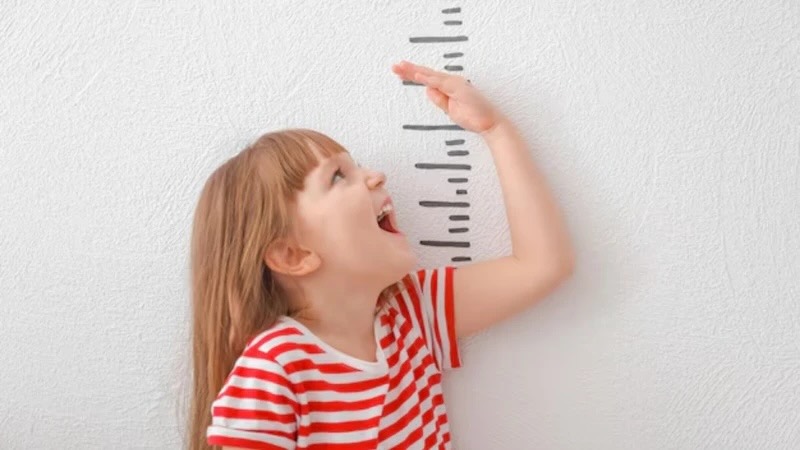
Measure a 2-year-old on a flat floor against a straight vertical surface, with shoes removed and the child’s body positioned as consistently as possible. A proper measurement reduces errors caused by footwear, posture, movement, or an uneven measuring surface.
Start by removing the child’s shoes and bulky hair accessories. Place the child on a hard, level floor with their back against a wall or another flat vertical surface. Position the feet flat on the floor and keep the legs as straight as the child comfortably allows. The child’s head should face forward rather than tilt upward or downward.
Place a flat object, such as a rigid book, horizontally on top of the child’s head so that it forms a right angle with the wall. Mark the point where the bottom of the object meets the wall, then measure vertically from the floor to that mark. Recording the result in both inches and centimeters makes future comparisons easier because pediatric growth charts commonly use metric measurements.
Standing height is especially relevant around age 2 because growth monitoring transitions from measuring an infant’s recumbent length while lying down to measuring standing height. These two measurements are not perfectly interchangeable. The method used should therefore be recorded when parents compare measurements taken at different ages.
Toddlers also move during measurements, which can introduce errors. Taking two measurements during the same session can help identify an obvious measuring mistake. If the numbers differ substantially, reposition the child and measure again instead of averaging measurements taken with poor posture.
How Do You Convert a 2-Year-Old’s Height From Inches to Feet?
Convert a toddler’s height from inches to feet by dividing the total number of inches by 12. One foot contains 12 inches, so every complete group of 12 inches represents one foot, while the remaining inches are stated separately.
For example, a child who measures 34 inches is 2 feet 10 inches tall because 24 inches equals 2 feet and 10 inches remain. A measurement of 33 inches equals 2 feet 9 inches, while 36 inches equals exactly 3 feet.
The same conversion can be used when a pediatric record provides height in inches but parents want an easier way to visualize it. Keep the original measurement as well, because inches or centimeters are more precise for plotting small changes in toddler growth than rounded measurements expressed only in feet.
How Much Do 2-Year-Olds Grow Between Ages 2 and 3?
A 2-year-old typically gains several inches in height before turning 3, but the exact amount differs between children. Growth during the toddler years is slower than the rapid growth that occurs during infancy, so parents should not expect height to increase at the same pace seen during a child’s first year.
Growth over time provides more useful information than the number of inches gained during one short period. A child can grow unevenly, with faster increases during one period and slower increases during another. For this reason, measurements taken over several months provide a clearer picture than measurements taken only a few weeks apart.
For example, parents can record height at age 2, compare it with measurements taken during routine checkups, and then review the pattern again around age 3. Using the same measuring method each time reduces variation caused by shoes, posture, measuring surfaces, or switching between standing height and recumbent length.
A child’s growth rate should also be considered alongside their existing height percentile. A shorter toddler who continues growing along a relatively consistent trajectory presents a different pattern from a child whose growth rate slows substantially and whose position on the growth chart changes over time. This is one reason pediatric growth assessment relies on serial measurements rather than a single height value.
What Factors Affect a 2-Year-Old’s Height?
A 2-year-old’s height is influenced by several connected factors, including genetics, nutrition, overall health, and the child’s individual growth pattern. These factors help explain why two healthy toddlers of exactly the same age can differ noticeably in height.
Genetics plays an important role because biological parents pass on traits associated with stature and growth. A toddler with shorter parents may naturally follow a lower height percentile than a toddler with taller parents. Genetics does not determine one guaranteed final height, however, because growth reflects interactions between inherited characteristics and the child’s development and environment.
Nutrition supports the physical processes required for normal growth. Toddlers need adequate energy as well as nutrients such as protein, calcium, iron, vitamin D, and other vitamins and minerals as part of an age-appropriate diet. Nutrition should be viewed as supporting normal growth rather than as a way to make a healthy child taller than their inherited growth potential.
Overall health can also influence growth. Height gain depends on normal development across multiple body systems, which is why pediatricians evaluate growth as part of a child’s broader health rather than interpreting height in isolation. When growth concerns exist, information about weight, development, eating patterns, medical history, and previous measurements can provide additional context.
Individual timing creates further variation. Children do not gain height in perfectly equal increments each month, and two toddlers can follow different trajectories while both developing appropriately. This variation is why comparing a child with siblings, friends, or other toddlers at daycare is less informative than following the child’s own measurements over time.
Does a 2-Year-Old’s Height Predict Adult Height?
A 2-year-old’s height can provide limited information about future stature, but it cannot determine exact adult height. Adult height results from genetics combined with years of growth and development, so a toddler’s current measurement should be treated as one early data point rather than a final prediction.
A commonly discussed shortcut is to estimate adult height by doubling a child’s height around age 2. For example, doubling a height of 34 inches produces an estimate of 68 inches, or 5 feet 8 inches. This calculation is simple, but it should not be interpreted as a guarantee that a 34-inch-tall toddler will reach exactly 5 feet 8 inches as an adult.
The limitation comes from the years of growth that remain. Children differ in growth velocity, timing of puberty, inherited stature, and other developmental factors. A toddler who is relatively tall at age 2 will not necessarily occupy exactly the same relative position among peers throughout childhood and adolescence.
For parents, height at age 2 is therefore more useful for monitoring current growth than predicting final adult height. Tracking measurements on an appropriate growth chart answers the immediate question of how a toddler is growing, while estimates of adult height contain substantially more uncertainty.
When Should Parents Ask a Pediatrician About Their 2-Year-Old’s Height?
Parents should ask a pediatrician about their 2-year-old’s height when the child shows an unusual growth pattern, grows substantially more slowly than expected, or has a height that falls at an extreme end of the growth chart. A single measurement above or below average is less informative than the direction of the child’s growth over time.
One indicator that deserves attention is a significant change across percentile curves. The American Academy of Pediatrics explains that children generally grow roughly parallel to their established percentile lines. A child who progressively moves downward across those lines—for example, from around the 25th percentile toward the 5th percentile—may need further assessment because the change can indicate slower-than-expected growth.
Very short stature can also justify a conversation with a pediatrician. The American Academy of Pediatrics notes that short stature is commonly used for children whose height falls below approximately the 3rd or 5th percentile for their age and sex. This does not mean every short toddler has a medical problem. Genetics can explain why a healthy child with shorter parents consistently follows a lower growth curve.
Growth charts therefore work best as a tracking tool rather than a scorecard. The CDC states that accurate measurements, exact age, an appropriate reference population, and a sex-specific chart are important when assessing childhood growth. Comparing the current percentile with previous measurements helps health professionals identify major shifts that may require additional assessment.
Parents should also discuss height with their pediatrician when growth concerns occur alongside changes in weight, nutrition, development, or overall health. Genetics, nutrition, environment, and health conditions can all influence a child’s growth, so height is more meaningful when considered as part of the child’s broader development.
The same principle applies to a toddler who appears unusually tall or is growing much faster than expected. Being taller than average is not automatically a problem, but the American Academy of Pediatrics recommends discussing unusually rapid growth with a pediatrician, who can determine whether further evaluation is appropriate.
For most parents, the key question is therefore not whether a 2-year-old matches the average height exactly. A consistent growth trajectory matters more than reaching the 50th percentile. Bringing previous measurements to well-child visits gives the pediatrician a clearer picture of whether the toddler is continuing along an expected growth pattern.